
Your money isn't about money.
It's about the people who rely on you.
Before we talk about portfolios, we start with the people your wealth is for.
The Family Map puts your parents, children and grandchildren on one page, shows who holds which role in your plan, and points out what needs attention.
Watch: The Family Map in 45 seconds
Made for families with a lot going on.
If one of these sounds like you, the Family Map is a good place to start.
Your parents are getting older
You may be helping with their care, waiting on an inheritance, or both, and you're not sure what their plan says.
Your kids have kids of their own
Marriages, grandchildren and blended families mean the plan you signed years ago may not fit anymore.
You sold, or are selling, a business
A liquidity event changes what your family will receive, and who you need in place to manage it.
Why we start with your family
Most of the families we work with didn't build their wealth for themselves. They built it for the people around them: aging parents, children starting their own families, grandchildren they want to help.
Those people shape every part of a good plan. Who you name as executor and trustee. How an inheritance should pass. What happens when a parent needs care. So before we look at a single account, we sit down and map out your family together.

"The people in our lives are what matter most. My family reminds me of that every day, and it's why every Atlas plan starts with yours."
Kyle Walters, Founder
What's on your Family Map
One page. Everyone who matters. What to do next.
01
Four generations, one page
Your parents, siblings, children and grandchildren. Who they are, where they live and what's going on in their lives.
02
Who holds which role
Your executor, trustee, guardians, powers of attorney and beneficiaries, marked right on the tree.
03
What needs attention
For example, an executor who now needs care himself, or documents signed before the grandkids were born.
04
A clear way forward
What's on track, what we'd suggest, and the next steps we'll take together with your attorney and CPA.
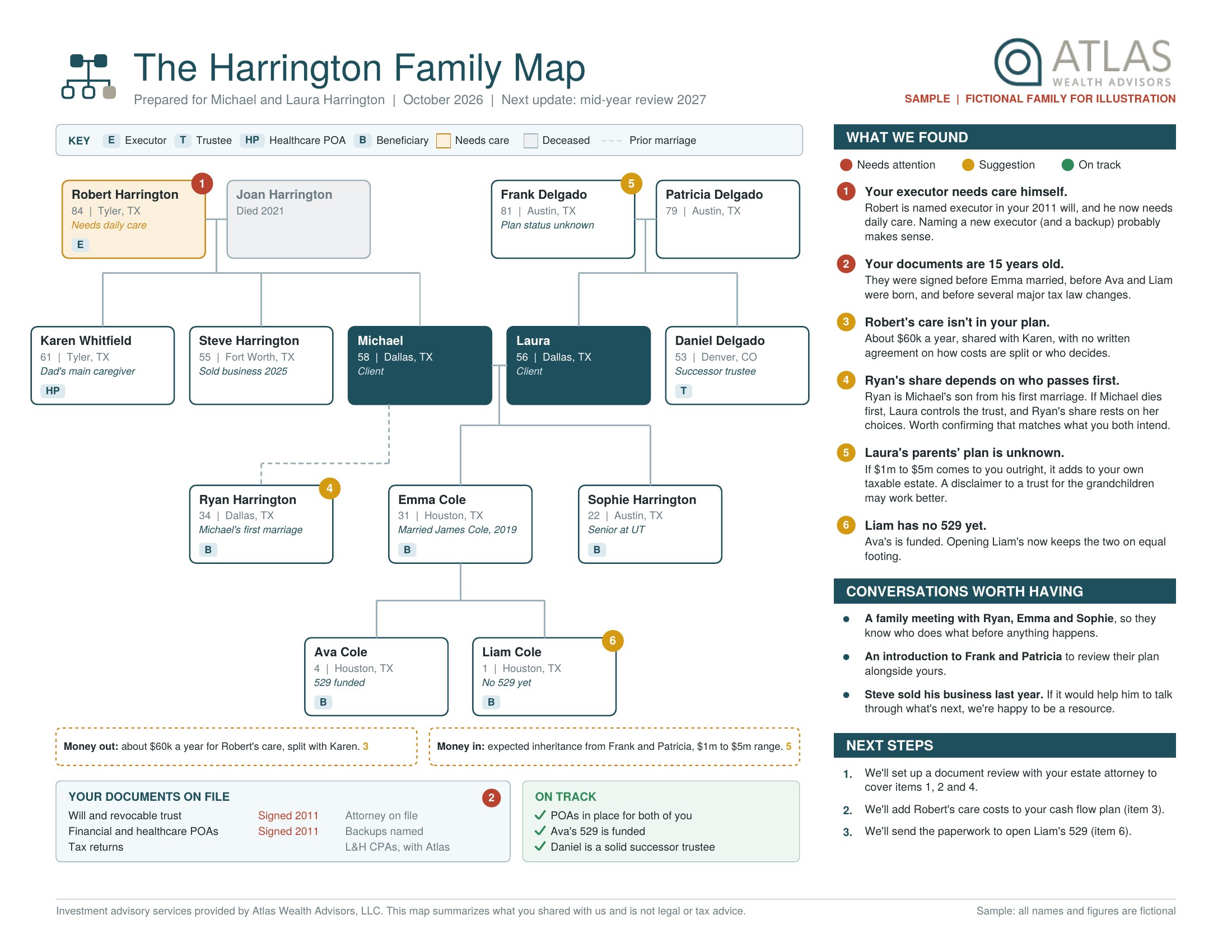
A sample Family Map. All names and figures are fictional.
How it works
Step 1
A conversation about your family
About 45 minutes. You tell us about the people who matter most, and we fill in the map together. No documents needed to start.
Step 2
We review your documents
Your will, trust and powers of attorney, so the roles on your map reflect what's actually in place.
Step 3
You get your Family Map
Within about two weeks. We walk through it with you, then update it at every review as your family changes.
Not ready to talk yet?
Download the blank Family Tree and sketch out your family on your own. It takes about ten minutes, and it's a good way to see what questions come up.
Questions
What is a family map in financial planning?
It's where we start: figuring out who the most important people in your life are. For most families, your money isn't really about money at all. It's about the people who rely on you.
The Family Map puts those people on one page: your parents, siblings, children and grandchildren, where they live and what's going on in their lives. Then we mark who holds which role in your plan (executor, trustee, guardian, power of attorney, beneficiary) and flag anything that needs attention.
Every other part of your plan builds from there. Your investments, your taxes and your estate plan should all serve the same people, so it makes sense to know who they are first.
How do I know if my estate documents are out of date?
Start with a simple test: has your family changed since you signed them? If so, they're probably worth a look.
Common reasons to review include a marriage or divorce (yours or your children's), a birth or adoption, a death in the family, a move to another state, the sale of a business, or a big change in what you own.
For example, a will signed before your grandchildren were born may not mention them at all, and the executor you named 15 years ago may now need care themselves. We check the dates on your documents as part of the Family Map, and if something needs updating, we work through it with your estate attorney.
How should I choose an executor or trustee?
There isn't one right answer, but a few questions help. Is this person able and willing to do the job? Are they likely to be around when it's needed? Do they live close enough to handle things in person? And will the rest of the family trust them?
We often see someone named years ago who is now older, in poor health or living across the country. It's also common to name the same person for every role, which can put a lot on one family member. In some cases it probably makes sense to name a co-trustee or a professional trustee alongside them.
The Family Map shows these roles at a glance, so gaps are easy to spot. Any changes go through your estate attorney.
How often is the Family Map updated?
We review it at every client review, and anytime your family changes: a new grandchild, a marriage, a parent who needs more help. Families change faster than documents do, so the map should keep up with them.
Do I need to bring anything?
Not for the first conversation. We just want to hear about your family.
After that, we'll ask for your will, trust and powers of attorney so we can confirm who is actually named where. People often remember their documents a little differently than they're written, and the Family Map should reflect what's really in place. If you aren't sure where your documents are, that's common too, and we can help track them down with your attorney.
Who sees my Family Map?
Your Family Map is for you and your spouse or partner. We share it with your attorney or CPA only when you ask us to.
Some families choose to walk through it with their adult children, for example as part of a family meeting. That's always your call.
Does Atlas replace my estate attorney?
No. Your estate attorney drafts and updates your legal documents, and your CPA handles the tax side. The Family Map shows where things stand and what's worth a closer look, so those conversations start in the right place.
As your Personal CFO, we coordinate with your attorney and CPA so everyone is working from the same picture of your family.
Investment advisory services provided by Atlas Wealth Advisors, LLC. Dallas, Texas. The Family Map summarizes what you share with us and is not legal or tax advice.